
At the same time that we continue marking Black History Month, we are also confronted in the United States with the astounding, appalling, unforgivable and racist actions not only of Donald Trump (convicted felon, liable party to numerous civil suits, pathological liar, loser of more than 60 lawsuits over the 2020 election Big Lie), but also his henchmen and -women who support, condone and enable these actions.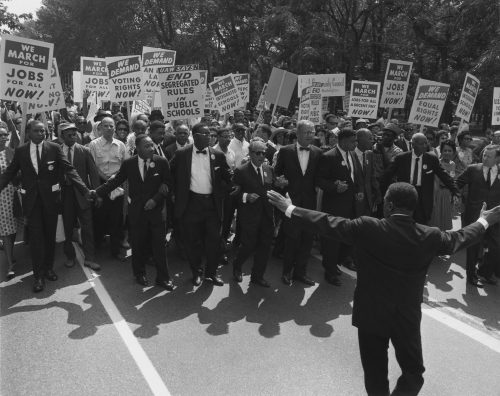
In this time of attacks on everything that is deemed “unfair” to whites, as many Americans malign anything under the banner of “diversity, equity and inclusion,” we will pivot to a much more positive, hopeful and inspiring narrative. All of us have benefited greatly from the contributions of those who, for the most part, were or are descended from slavery, our national sin – and we need to acknowledge their contributions with gratitude. Here is a small sampling of women and men, in alphabetical order, about whom we should know.
Sarah Boone (1832-1904). Born Sarah Marshall in slavery in North Carolina, Sarah married a freedman in her teens and, by 1856, the couple was living in Connecticut with their eight children. In the 1890s while working as a dressmaker – for both white and Black women – in New Haven, Sarah invented and patented an ironing board with collapsible legs (Patent No. 473,653), thus freeing women from ironing awkwardly on tables or planks between two chairs. The new board also allowed for ironing the sleeves and bodices of women’s clothes. Sarah’s husband James Boone worked as a bricklayer and died in the mid-1870s. Records indicate that Sarah was successful enough in her business to own her own house. Possibly thanks to being a member of the Dixwell Congregational Church, she appears to have learned how to read and write in her late 40s, which allowed her to apply for the patent.
Marie van Brittan Brown (1922-1999). Home security systems are now not only in use across the country but also frequently assist law enforcement in solving crimes. The systems’ invention can be traced back to Brown, who was raising children with her husband, Albert Brown, in New York City and became concerned about everyone’s safety. Working as a nurse that involved long hours and shifts at different times of day, Marie Brown “rigged a motorized camera to record her home entryway and project images onto a TV monitor.”  The system also included a two-way microphone to communicate with visitors without needing to open the door and a panic button to alert police. Her system was too expensive to be widely marketed, but it laid the groundwork for modern CCTV security systems and is cited in 35 American patents.
Thomas L. Jennings (1791–1859). Jennings received US Patent No. 3306x for the dry-cleaning process called “dry scouring,” which became the predecessor to modern dry-cleaning techniques. For this, he became the first African American to receive a US patent. Jennings was a skilled tailor and successful businessman in New York City, as well as a contributing citizen in many other ways: “founder and trustee of the Abyssinian Baptist Church, assistant secretary for the First Annual Convention of the People of Color in Philadelphia in 1831, and [organizer of] the Legal Rights Association in 1855.” How many Americans (and others around the world) today benefit from Jennings’ talents, determination, and intelligence?
Frederick McKinley Jones (1893-1961). Who among us has not benefited from mobile refrigeration – the ability of companies to transport the food we eat long distances? For this, we owe thanks to an African American, Frederick McKinley Jones. His personal story, like that of so many of our Black fellow citizens, is also inspiring due to the obstacles he overcame and the many things he accomplished in his life. Born in Cincinnati from a white father and Black mother (who deserted the family), Jones was sent to live with a priest in Kentucky for two years, and his father died during this time. Jones ran away and returned to Cincinnati, where he held various jobs and realized he was skilled at auto mechanics. In 1912, he ended up on a farm in Hallock, Minnesota, doing mechanical work. Over time, he taught himself both mechanical and electrical engineering and earned an engineering license. In the Army during World War I, his superiors recognized his skills, he was promoted to sergeant and worked as an electrician, wiring telephones and telegraphs and repairing X-ray machines and other equipment. Back on the farm in Hallock after the war, Jones’ wide range of skills led him to create the transmitter of a new radio station, a device to combine moving pictures with sound, and a machine for movie box offices that delivered tickets and offered change to customers – the latter earning him his first patent in 1939. Through collaboration with local businessman Joseph A. Numero and due to Jones’ groundbreaking design of a portable air-cooling unit for trucks carrying perishable food, the US Thermo Control Company, now known as Thermo King, was born.  Jones later adapted the air-cooling device for trains and aquatic vehicles, thereby allowing fresh produce to be made available anywhere in the US year-round. During World War II, Jones’ inventions helped save lives through the preservation of blood serums for transfusions, medicine, and food. In 1944, the “King of Cool,” who received more than 60 patents, became the first Black American elected to the American Society of Refrigeration Engineers. Jones unfortunately died relatively young at age 67, but Thermo King Corporation is still going strong, and he has received a number of other awards posthumously.
Elijah McCoy (1844-1929). McCoy’s parents were George and Mildred Goins McCoy: fugitive slaves from Kentucky who made their way to Canada via the Underground Railroad. Elijah was born in Ontario and moved to Ypsilanti, Michigan with his large family in 1847. After studying mechanics in Scotland, McCoy settled in Michigan after becoming certified as a mechanical engineer. We will not be surprised that he encountered racial barriers, despite his skill. Eventually, however, he became a fireman and oiler for the Michigan Central Railroad, where his talents finally paid off – to the tune of over 60 patents. He first invented a lubricating cup that distributed oil evenly over train engines’ moving parts, thus allowing “trains to run continuously for long periods of time without pausing for maintenance.” What is perhaps even closer to home for most of us are his inventions of the ironing board and lawn sprinkler.
Alexander Miles (1838-1918). Most of us have ridden in elevators. We have Alexander Miles to thank for the safe automatic doors (US Patent No. 371,207) – and that we don’t crash to the bottom of the shaft. Born in Ohio, Miles lived at various times in Wisconsin, Minnesota, Chicago, and finally Seattle. While working as a barber in a four-story building in Duluth, Minnesota, and then purchasing a three-story brownstone, Miles noticed the inadequacies and even dangers of the buildings’ elevators. People periodically fell to their death in the shaft when one of the two elevator doors was accidentally left open (since they were manually operated). Miles put his mind to the problem and developed the mechanism that basically survives to this day: a flexible belt attached to the elevator cage that touched drums positioned along the shaft, thus allowing the doors to operate at the correct times.  Unlike many inventors, his invention was successful financially, and he ultimately became known, by the time of his death, as the wealthiest Black person in the Pacific Northwest. Miles started The United Brotherhood, a life insurance company for Black customers who could not receive coverage from white-owned firms, and had earlier become the first Black member of the Duluth Chamber of Commerce.
Alice H. Parker (1895-1920). Those of us who stay warm in the winter thanks to a central heating system owe Alice H. Parker a debt of gratitude. Parker was already remarkable early in her life by being an African American woman who attended classes at Howard University at a time when women in general, let alone Black women, could not pursue higher education. Hailing from New Jersey, the cold winters inspired her to improve upon an existing furnace design to utilize natural gas – thus saving homeowners enormous amounts of time chopping wood – and “increased safety measures without a fire burning all night.” Parker’s patent, No. 1,325,905, granted in December 1919, “uniquely involved a multiple yet individually controlled burner system” and became the precursor to our current heating zone systems and thermostats. The New Jersey Chamber of Commerce annually honors her legacy with the Alice H. Parker Women Leaders in Innovation Awards.
Concluding Thoughts
The right wing of our political system has a strand of belief and rhetoric that promotes the twisted notion that celebrating and highlighting the successes and contributions of people who are not white (or Christian, or straight, or male…) equates to diminishing the contributions of white/Christian/straight/male people. This zero-sum ideology maintains that initiatives and programs that elevate one group diminish others and are thus illegitimate and not worthy of support, legal protection, or other social benefits. How soon these Americans forget; most of us of a certain age learned in school mainly about the primarily straight, white men who had enormous success throughout our history – from presidents to leaders of industry to politicians to explorers to law enforcement officials to inventors. People of color had almost no role models in this curricular design.
With the Civil Rights movement and affirmative action initiatives, we Americans began to understand this oversight and how detrimental it was to the common good. The new understanding strove to raise the profile of Americans who have historically been outside the mainstream; the point was not to diminish “majority” accomplishments but rather to level the playing field and ensure that the contributions of those who have previously been ignored or overlooked are illuminated, for everyone’s sake.
The zero-sum mentality of many on the right, as is hopefully evident from the above fact-based examples (and many more that cannot be described here), is not only unhistorical, ignorant, immature, naive, anti-democratic and racist but, most frighteningly, dangerous – it has led in our past and still leads to violence. It is one thing to think negative thoughts or feel negative emotions toward others; and we also have a First Amendment right to express these negative thoughts and feelings. However, there is no right to use inflammatory language to incite vandalism, harassment, assault, conspiracy or murder.
The grit, determination, talent, good will and courage of the Black Americans highlighted above should be an inspiration and example to all of us, not cause for envy, jealousy, pettiness, even hatred. The success of our fellow citizens, when their success is for the common good and not merely self-interest, should be celebrated, encouraged and emulated. And our laws across the country should enable this kind of success.