
The Advent and Christmas seasons in the West, especially in the United States, have become exceedingly consumerized. The origins of the seasons, of course, lie in antiquity, with the birth of Jesus and the stories about this as found in the Christian Testament Gospels and other early Christian literature. We have discussed stories about Jesus several times in the past. 
Stories around Mary, Jesus’ mother, have led to some of the most sublime music and art in the world. Even if one does not believe in the Christmas story, many of us are deeply moved by Mary’s song, known as the Magnificat, which comes from the Gospel of Luke 1:46-55. It starts, in Latin, “Magnificat anima mea Dominum” – “My soul magnifies the Lord.” Let us look in some depth at this aspect of the Mary story.
Origins
In the story as found in Luke, pregnant Mary visits her cousin Elizabeth, who is also pregnant. The baby inside Elizabeth, John the Baptist, leaps in her womb, which causes Elizabeth to tell Mary that she and her baby boy will be favored by God. Mary rejoices in the words of the Magnificat.
Luke’s gospel, written in Greek perhaps by a physician who was a companion of St. Paul, originally circulated in the Roman Empire between 80 and 130 CE (Common Era). This was well after the life and death of Jesus of Nazareth, the focus of Luke’s “good news.” While the Gospel-writer used words, phrases and stories similar to those recorded in two of the other Gospels – Mark and Matthew – the text of the Song of Mary is unique to Luke.
Luke did not completely invent the Song: he patterned it after that of Hannah in the Old Testament/Hebrew Scripture book of 1 Samuel (Chapter 2, verses 1-10). The historical figures in the story of Jesus – Jesus himself, Mary his mother, Joseph his earthly father, most of his followers, St. Paul, etc. – were Jewish. It was only after the Romans destroyed the Temple in Jerusalem in 70 CE that “Christianity” emerged as a religion separate from Judaism. Even after this parting of the ways, many readers and hearers of Luke’s Gospel would have been familiar with ancient Jewish texts, including the story of Hannah.
Luke probably had very little real information about the historical Mary. 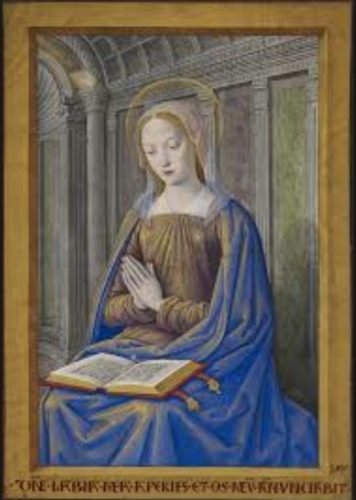 Like the other Gospel writers (and authors of many other examples of early Christian literature), Luke had certain theological reasons for telling this story of Mary’s visit to Elizabeth. At the very least, Luke is making connections for his readers between their lives in the early Roman Empire and the history of the Jews. He wants to relay the “good news” of God’s actions on behalf of humanity.
Hannah – another woman experiencing a miracle having to do with the birth of her child – thus provided a model for the figure of Jesus’ mother and the God-ordained events around the women and their sons. There are some differences in the stories, but the main parallels are that the women sing songs of thanks and praise to God for what has happened in their lives and celebrate God’s works and actions on behalf of the poor and downtrodden.
The Magnificat in Church Tradition and Music
The Bible, including the Christian Testament and thus the Song of Mary, has been translated into Latin and almost every language in the world over the millennia. At some point, the Magnificat crept into church liturgies. Today, the so-called Daily or Divine Office of the Roman Catholic, Orthodox, Anglican and Episcopal traditions contains the Magnificat; that is, monks, nuns, many priests and even laypeople recite, chant or sing Mary’s Song daily. It is most often included in Evening Prayer/Vespers (along with the Nunc Dimittis/Song of Simeon). Because of its appearance in these liturgical settings, the Magnificat has been set to music by dozens of composers over the centuries; in fact, it is one of the most popular Biblical texts for composers.
Words of Subversion
In her book Amazing Grace, author Kathleen Norris notes that both the Hannah and Mary passages are “a poetic rendering of a theme that pervades the entire biblical narrative – when God comes into our midst, it is to upset the status quo” (117). Norris goes on to relate that the message of the Magnificat is so subversive that the government of Guatemala banned its public recitation back in the 1980s. This means that nuns, monks, priests and laypeople were using subversive words on a regular basis in their daily prayers!
It is these words of Mary that most bother rulers and people in power – especially those who abuse their power:
“He [God] has shown the strength of his arm,
He has scattered the proud in their conceit.
He has cast down the mighty from their thrones,
And has lifted up the lowly.
He has filled the hungry with good things,
And the rich he has sent away empty.”
When we hear, read, chant or sing this amazing text, whether we are Christian or not, maybe we can muse not only on those things for which we are grateful but also on the text’s vision of justice and the “lifting up of the lowly.”
For Further Reading
Abrahamsen, Valerie. “Mary, Mother of Jesus,” in Bruce M. Metzger and Michael D. Coogan, eds., Oxford Companion to the Bible, 499-500. New York and Oxford: Oxford University Press, 1993.
Fitzmyer, Joseph A., SJ. “Luke, The Gospel According to,” in Bruce M. Metzger and Michael D. Coogan, eds., Oxford Companion to the Bible, 469-74. New York and Oxford: Oxford University Press, 1993.
Klein, Lillian R. “Hannah,” in Carol Meyers, Toni Craven and Ross S. Kraemer, eds., Women in Scripture: A Dictionary of Named and Unnamed Women in the Hebrew Bible, the Apocryphal/Deuterocanonical Books, and the New Testament, 90-91. Grand Rapids, MI, and Cambridge, England: William B. Eerdmans Publishing Company, 2000.
Limberis, Vasiliki. “Mary 1,” in Carol Meyers, Toni Craven and Ross S. Kraemer, eds., Women in Scripture: A Dictionary of Named and Unnamed Women in the Hebrew Bible, the Apocryphal/Deuterocanonical Books, and the New Testament, 116-19. Grand Rapids, MI, and Cambridge, England: William B. Eerdmans Publishing Company, 2000.
Norris, Kathleen. Amazing Grace: A Vocabulary of Faith. New York: Penguin Putnam Inc., 1998.
Wikipedia has a long list of composers who have set the Magnificat (and sometimes also the Nunc Dimittis) to music. Some of these include Palestrina, William Byrd, Orlando Gibbons, Heinrich Schütz, Charpentier, Pachelbel, Purcell, Vivaldi, Telemann, JS Bach, CPE Bach, Johann Christian Bach, Mozart, Healey Willan, Mendelssohn, Liszt, Hubert Parry, Charles Villiers Stanford, Ralph Vaughan Williams, and Rachmaninoff.
——————————————————————–
This article is adapted from a piece that was offered to members of the Brattleboro Concert Choir in Fall 2021.